
Create a maintenance checklist for high-performance two-stroke dirt bikes
Keep your high-performance two-stroke dirt bikes running at peak power and reliability with this structured maintenance checklist, organized by frequency.
Before Every Ride (Pre-Ride)
-
- Tire Pressure: Check and set pressure (typically 12–14 PSI, lower for slick/mud, higher for rocks).
- Chain Inspection: Check tension (about two to three fingers slack) and lube with fresh chain lubricant.
- Air Filter: Verify the foam filter is clean and properly oiled.
- Fluid Levels: Check coolant level in the radiator and inspect for any external leaks.
- Controls & Brakes: Test throttle free-play, clutch action, and brake lever firmness.
- Fasteners: Tap/check critical bolts like axle nuts, handlebar clamps, and sprocket bolts.
- Premix Fuel: Ensure fuel is mixed accurately at your manual’s recommended ratio (e.g., 32:1 or 50:1) with quality two-stroke oil.
After Every Ride (Post-Ride) dirt bikes
-
- Wash Gently: Wash off mud using low-pressure water, avoiding direct high-pressure spray on wheel bearings, linkage, and fork seals.
- Air Filter Care: Remove, wash, dry, and re-oil the air filter if you rode in dusty or wet conditions.
- Dry & Protect: Hand-dry the bike and spray metal components with a light rust inhibitor (avoiding brake rotors and pads).
- Chain Maintenance: Clean, dry, and re-lube the chain immediately after washing.
- Post-Ride Check: Look over the bike for loose spokes, cracked plastics, or worn brake pads.
Every 5–15 Riding Hours
-
- Transmission/Gear Oil: Change the gearbox oil while the engine is warm.
- Spark Plug: Inspect or replace the spark plug to prevent misfires and hard-starting.
- Carburetor/Reeds: Inspect carburetor jets, float bowl, and reed valves for chips or wear.
- Fork Bleeding: Bleed built-up air pressure from the top of the forks.
- Grease Chassis: Grease steering stem, swingarm, and linkage bearings depending on riding conditions.
Every 20–40+ Riding Hours (Periodic / Major)
-
- Top-End Rebuild: Inspect/replace the piston, rings, and wrist-pin bearing (interval varies by displacement and riding intensity; high-revving 125s need it sooner than 300cc enduros).
- Power Valve: Clean carbon buildup off the power valve assembly during top-end service.
- Suspension Service: Change fork oil and inspect seals (every 15–25 hours); service rear shock periodically.
- Coolant Flush: Completely flush and replace the radiator coolant.
- Driveline Wear: Check sprockets for hooked teeth and replace the chain and sprockets as a set.
Shifting from traditional two-strokes to ultra-modern high-performance electric dirt bikes (E-Motos) like the E Ride Pro SS, Rawrr Mantis X / Pro, and Surron Light Bee X completely changes your maintenance priorities. [1, 2
You trade engine oil changes, top-end piston rebuilds, and air filters for battery health, belt tracking, jackshaft alignment, and specialized gearbox oil. Because electric motors deliver instant, maximum torque, they place massive mechanical stress on the drivetrain.
The core maintenance breakdown for prominent high-performance E-Motos outlines these needs:
| Maintenance Metric | E Ride Pro SS | Rawrr Mantis (X / Pro) | Surron Light Bee X |
|---|---|---|---|
| Primary Drivetrain | Dual Stage: Inner Belt Drive + Outer Chain | Internal Mechanical Gearbox + Outer Chain | Dual Stage: Inner Belt Drive + Outer Chain |
| Lubrication Needs | Dry system: Inner belt requires periodic silicone spray; outer chain requires lube | Wet system: Internal gearbox requires actual gear oil; outer chain requires lube | Dry system: Inner belt requires tracking adjustments; outer chain requires lube |
| Gearbox/Transmission Fluid | N/A (No internal oil) | 60 mL of GL4 75W-90 / 85W-90 gear oil | N/A (No internal oil) |
| Fluid Change Interval | N/A | Break-in change at 120–300 miles, then every 500–600 miles | N/A |
| Brake Fluid Type | Mineral Oil or DOT 4 (depends on upgraded master cylinders) | Strictly Mineral Oil (do not use DOT4) | Mineral Oil |
| Recommended Tire Pressure | 12 – 15 PSI for dirt / trail riding | 32 PSI Front / 40 PSI Rear (Factory street/hard-pack specs; lower for soft dirt) | 15 – 22 PSI for trail riding |
Tailoring Maintenance for High-Performance E-Motos( dirt bikes )
If you ride an E Ride Pro SS (or Surron):
-
- Manage Belt Tracking & Tension: The internal primary belt is a known wear item due to the bike’s raw power. Spray it with specialized silicone spray to reduce friction. When adjusting the motor to center the belt, ensure it is not overtightened, or it will cause frame rub and snap prematurely. Many hard-enduro riders eventually swap this out for a chain-drive conversion kit.
- Service the Jackshaft: The jackshaft connects your internal belt drive to your external sprocket. During major inspections or winter storage, pull the jackshaft, clean out debris, and apply fresh waterproof grease to its bearings.
If you ride a Rawrr Mantis (X or Pro):
-
- Master the Mini-Oil Change: Unlike a Surron, the Mantis features an enclosed internal mechanical gearbox that requires routine oil changes. Use a syringe to carefully inject exactly 60 mL of GL4 gear oil through the fill hole. Use GL4 specification oil; common GL5 oils contain sulfur compounds that can corrode the internal copper/brass components over time.
- Burp Air Bubbles: After refilling the Mantis gearbox, put the bike into “Eco Mode” and gently blip the throttle while on a stand to let the rear wheel spin. This “burps” trapped air pockets out of the tiny gear case so you can verify the fluid is perfectly level.
- Check the Chain Stretch: Because of the instant torque, the factory chain on a Mantis stretches rapidly and may require replacement around 120 miles. If it stretches too far, it will sag and dangerously rub against the kickstand spring when you roll the bike backward.
Critical Battery Maintenance (Universal Rule for All E-Motos) dirt bikes
- The “Cool Down” Rule: Never plug your battery into a charger immediately after a hard, aggressive ride. The cells will be hot, and charging them while hot severely degrades cell longevity. Wait 30 minutes for the battery to cool to ambient temperature before plugging it in.
- Storage Charge: If you aren’t going to ride for more than 2 weeks, do not leave the battery sitting at 100% or drained at 0%. Flip the main breaker switch off, pull the battery out, and leave it resting between 20% and 80% (ideally around 60–70%) in a cool, dry place.
- Washing Care: These bikes carry high-voltage 72V electrical systems. While the batteries boast water resistance (like the Pro SS’s IP67 rating or the Mantis’s IP55 rating), never use a high-pressure washer directly on the battery housing, controller, wiring loom, or display dashboard. It forces water past rubber seals and fries electronics. Remove the battery completely before using high pressure on the frame.
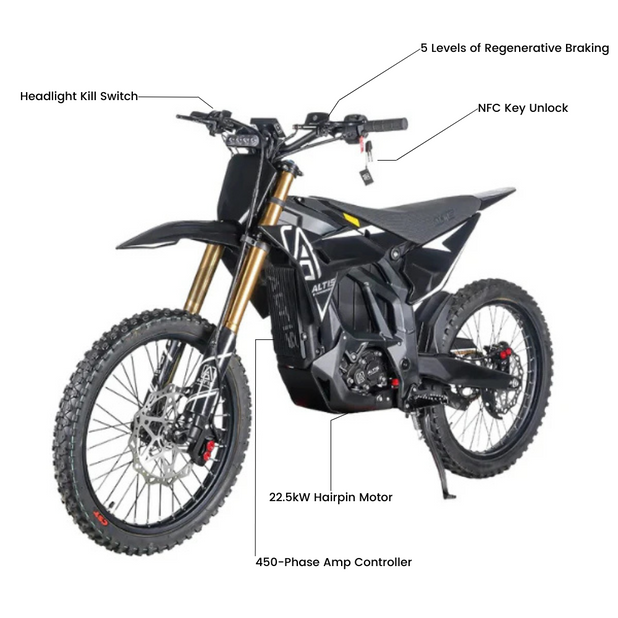
Expanding your stable to include brands like Talaria, 79Bike, Altis, and Tork brings engineering diversity to light. While these models represent high-performance E-Motos, their maintenance priorities differ dramatically.
Talaria uses a fully enclosed gearbox, Altis utilizes massive motorcycle-grade components to manage immense voltage, 79Bike balances lightweight belt-and-chain layouts, and Tork uses a direct-gear reduction setup that eliminates standard jackshaft hassles entirely.
The mechanical specs and core maintenance rules for these models are summarized here:
| Maintenance Metric | Talaria Sting R (MX4) | 79Bike Falcon (Pro/GT) | Altis Sigma | Tork Pro Sport (2026) |
|---|---|---|---|---|
| Drivetrain Layout | Enclosed Gearbox + Final Drive Chain | Primary Belt (HTD 8M) + Final Drive Chain | Heavy-duty 520H Motorcycle Chain (Direct) | Direct Gear-Reduction (No Jackshaft) + Chain |
| Lubrication Needs | Wet system: Sealed internal gearbox oil | Dry system: Belt tracking adjustment + chain lube | Dry system: External chain lube only | Dry system: Internal gear reduction is grease-sealed; chain lube |
| Fluid Specs / Volume | 70 mL – 90 mL of GL-5 85W-90 gear oil | None (Belt/Chain) | None (Direct Chain Drive) | None (Sealed gear casing) |
| Fluid Change Interval | Break-in: 186 miles (300 km). Routine: Every 1,000–3,000 miles. | N/A | N/A | N/A |
| Brake Fluid Type | Mineral Oil | Mineral Oil | DOT 4 or Mineral (Depends on master cylinder) | Mineral Oil |
Tailoring Maintenance for These Next-Gen E-Motos ( dirt bikes )
If you ride a Talaria Sting R (MX4):
-
- The “Sneaky” Gearbox Drain: Unlike a Surron’s open belt, the Talaria uses a completely sealed gearbox. Your absolute highest priority is the 186-mile break-in oil change. Factory machining leaves micro-shavings that will wear down your gears if not flushed.
- Do Not Overfill: The gearbox casing is incredibly small. Pouring in more than the specified 90 mL creates excessive internal pressure. This will blow out the rubber driveshaft seals and leak oil onto your rear tire.
If you ride a 79Bike Falcon (Pro or GT):
-
- Belt Tracking & Debris: The Falcon utilizes a multi-beam aluminum frame wrapping tightly around an HTD 8M primary drive belt. Because the belt sits inside a low-clearance channel, check for small rocks or trail gravel trapped between the belt teeth after mud rides. If a rock wedges in, it will puncture the belt under high load.
- Calibrate the 420 Chain: The Falcon Pro is incredibly light (130 lbs), but puts down high peak power. Watch your rear axle alignment notches carefully when tightening your chain to prevent side-loading your wheel bearings.
If you ride an Altis Sigma:
-
- Motorcycle-Grade Chain Care: The Altis Sigma is a heavy-duty powerhouse running a massive 97.2V battery and a 520H motorcycle chain. You don’t have a delicate bicycle-style chain here, meaning you must use heavy, fling-resistant motorcycle chain wax rather than thin bicycle lubricants.
- Axle and Caliper Checks: Because the bike produces a staggering 601 Nm of torque and weighs 185 lbs, the mechanical strain on the rear wheel structure is massive. Check the torque on the rear axle and brake caliper brackets every few rides to ensure nothing is backing out.
If you ride a Tork Pro Sport (2026):
- Zero Jackshaft Maintenance: Tork engineered their platform around a proprietary direct gear-reduction system that eliminates the jackshaft and primary belt entirely. This means no belt tensioning or alignment checks are needed. Simply focus on keeping the final drive chain clean and lubricated.
- Inspect the Battery Latch Lock: Because the Tork outputs up to 17kW of peak power via a heavy 72V 45Ah pack, its battery design incorporates a specialized mechanical latch lock system to prevent high-temp expanding connectors from vibrating loose over rough terrain. Always click and lock this latch explicitly before turning on the main breaker.
Two prominent but vastly different high-performance two-stroke dirt bikes illustrate how specifications change depending on displacement and intent: the Yamaha YZ125 (a high-revving motocross racer) and the KTM 300 XC-W (a flagship off-road/hard enduro machine).
A direct comparison highlights their exact fuel requirements, fluid capacities, and crucial maintenance intervals:
| Maintenance Metric | Yamaha YZ125 (2021–2026+) | KTM 300 XC-W (2020–2026+) |
|---|---|---|
| Primary Riding Style | High-RPM Motocross / Track | Tight Woods / Tech Trail / Hard Enduro |
| Fuel Delivery | Carburetor | Fuel Injected (TPI or TBI generation) |
| Fuel / Premix Ratio | 32:1 to 40:1
(Requires manual premixing) |
60:1 (TBI models require premix; TPI models auto-inject via oil tank) |
| Gearbox Oil Capacity | 660 mL (0.69 US Quarts) | 700 mL – 800 mL (0.74 – 0.85 US Quarts) |
| Recommended Fluids | Yamalube 10W-40 or wet-clutch equivalent | Motorex Top Speed 4T 15W-50 / JASO MA2 |
| Gearbox Oil Change | Every 5 hours (or every 2 race weekends) | Every 10–15 hours (sooner if abused in hard enduro) |
| Top-End Piston Rebuild | Every 20–30 hours (Due to constant high-RPM use) | Every 50–80 hours (High-torque lugging extends life) |
Tailoring the Checklist for These Prominent Machines
If you ride a Yamaha YZ125 (or any 125cc/150cc MX bike):
-
- Obsess Over the Air Filter: Small-bore 2-strokes are ridden wide open. A speck of dust entering at 11,000 RPM can ruin a cylinder instantly. Clean the filter after every single track day.
- Watch for “Spooge”: If black oil is dripping from your silencer, your premix might be too rich or your carburetor jetting is too fat for the weather.
- Strict Piston Intervals: Do not push a 125cc top-end past 35 hours if racing. The lightweight pistons twist and stress rapidly under constant high load.
If you ride a KTM 300 XC-W (or Husqvarna TE 300 / GasGas EC 300):
- Electronic Fuel Injection (EFI) Upkeep: If riding an oil-injected TPI model (2018–2023), check the under-seat oil tank every 2 fill-ups. If riding a newer TBI model (2024+), remember that even though it is fuel-injected, you must manually premix the gas at 60:1.
- The Oil Level Screw: When refilling the KTM gearbox, use the 8mm oil-level check screw on the clutch cover to verify the correct height. Overtightening this case screw will easily strip the threads, so torque it gently to 8–10 Nm.
- Power Valve Servicing: Because 300cc bikes are frequently “lugged” at low RPM through tight rocks and mud, they accumulate carbon faster. Clean the power valve linkage every time you replace the piston
Leave a Reply